































The United Nations’ World Urbanization Prospects 2025 (WUP 2025) is the world’s most important data source on global urban development. The study provides harmonized, geospatially based information on how metropolitan areas, cities, and rural regions will evolve through 2050 — covering 237 countries. For the first time, WUP 2025 applies the new “Degree of Urbanization” methodology, which consistently classifies urban areas and enables global comparisons. The findings show that urbanization remains one of the strongest structural megatrends of the 21st century, with profound effects on economies, markets, consumption, supply chains, and workforce structures.
Findings
1. Urbanization continues to advance
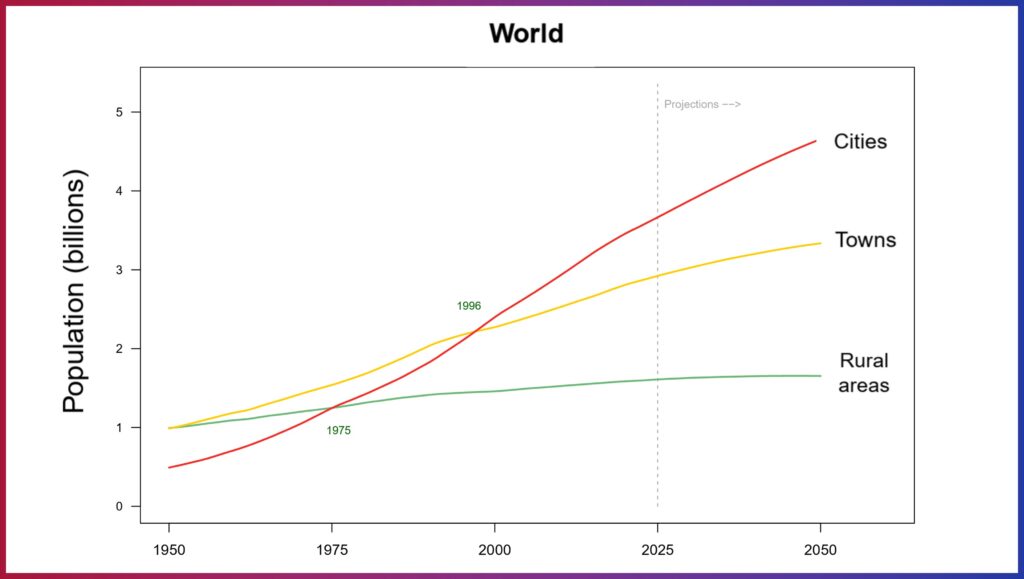
The projections show that by 2050, around two thirds of global population growth will take place in cities, while the majority of the remaining growth will be in smaller urban settlements. The global rural population is expected to peak in the 2040s and then begin to decline.
2. Africa and Asia are the new centers of global urban development
These regions will account for the largest share of future urban growth. For companies, this means that new customers, supply chains and growth paths will primarily emerge where millions of people are moving into urban areas.
3. Smaller and medium-sized cities are becoming the most important growth area
According to the report, the majority of the world’s population lives in cities with fewer than one million inhabitants – and many of these are among the fastest growing settlement areas in the world. This opens up market opportunities beyond the well-known megacities.
4. Urbanization is becoming more heterogeneous – growth and shrinkage occur simultaneously
Some cities are growing rapidly, others are losing population. Business decisions therefore require precise regional analyses instead of overarching assumptions about “the city”.
5. The need for urban infrastructure will grow structurally over decades
Urbanization is changing energy, water, transport, logistics, housing and digital infrastructure. The WUP 2025 clearly shows that the modernization and expansion of urban systems is a permanent investment driver.
6. Cities are becoming the most important lever for global climate and sustainability goals
Because they dominate resource consumption and emissions, they are becoming the focus of global politics. This is creating a lasting trend for companies: technologies and solutions for urban sustainability remain a growth market.
7. The concentration of labor in cities will shape global talent flows in the future
Increasing urbanization is creating a greater concentration of skilled workers, but also more competition. At the same time, African and Asian cities are creating new talent and innovation areas that are becoming relevant for companies.
8. The new geodata-based UN methodology makes urban markets globally comparable for the first time
The “Degree of Urbanization” method enables clear distinctions to be made between urban and rural areas. This facilitates market assessments, location decisions and international comparisons.