































The World Economic Forum’s new analysis shows that the global economy is not heading back to “business as usual” by 2030, but towards a new structurally different economy in which geopolitical power shifts and technological change are tightly intertwined. Global value creation is becoming more fragmented, regulation more uneven and technological advantages increasingly geopolitically relevant. For companies, this means less planning certainty and a greater premium on strategic adaptability.
The white paper builds on four futures that are not forecasts but structured scenarios, designed to illustrate how markets, technology use and geopolitical conditions could evolve in very different ways.
Four scenarios for the global economy in 2030
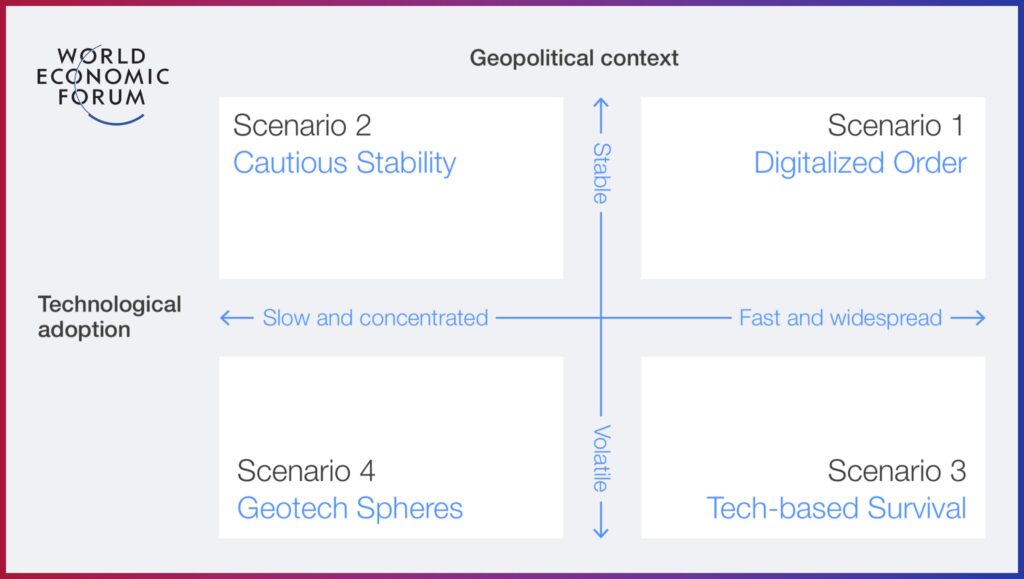
Digitalized Order
Geopolitical stability and rapid, widespread technology adoption revive growth and support a more digitally integrated global economy. At the same time, labour markets are reshaped, competitive pressure and inequality increase, and the risks of technology misuse call for much stronger governance.Cautious Stability
Geopolitical stability reduces risk and creates more predictable conditions, but growth remains weak as frontier technologies deliver only limited productivity gains and diffuse slowly. The benefits of innovation are concentrated among incumbent players, while jobs and wages change only gradually.Tech-based Survival
Widespread technology adoption creates new efficiencies, but takes place against a backdrop of persistent geopolitical volatility. Companies lean heavily on digital tools, AI and automation to cope with disruption, yet face fragmented markets, regulatory divergence and an environment where trust, coordination and stability are in short supply.Geotech Spheres
As geopolitical volatility increases, countries retreat into tighter geoeconomic blocs and regional trade circles. Growth slows, asset prices fall and, despite reshoring of production and critical technologies, talent and skills shortages persist. Technology develops in separate geotech spheres with reduced global interoperability and higher barriers between competing systems.
Why this matters for leaders and companies
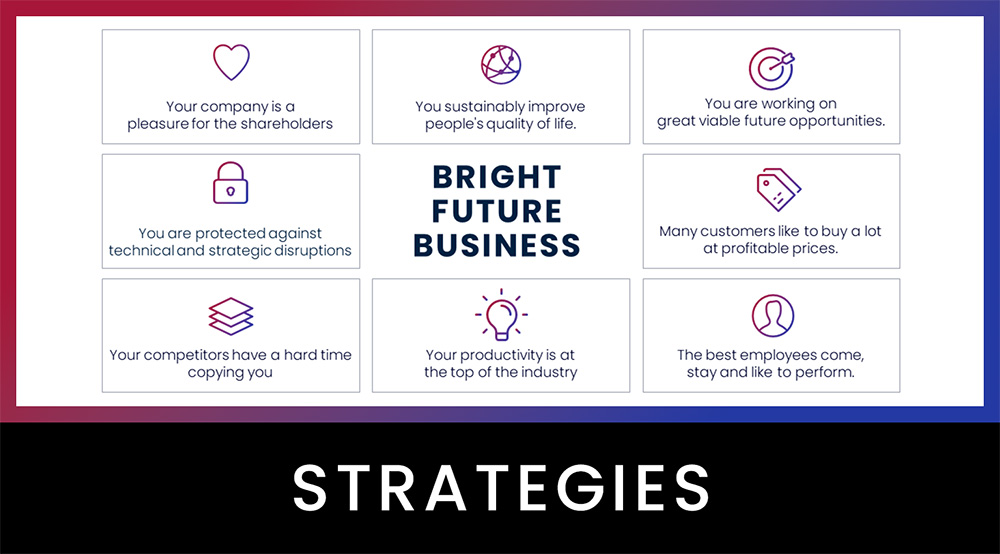
Across all four futures, global integration can no longer be taken for granted. Companies need strategies that are robust across multiple possible trajectories, actively manage their technological dependencies and build more resilient organizations. Competitive advantage will emerge where technological capabilities, geoeconomic insight and strategic flexibility come together.
No-regret strategies for the new economy
Strengthen core processes and operational excellence
Build geoeconomic intelligence and geopolitical capabilities
Enhance strategic foresight and data-driven decision-making
Invest in resilient and agile supply chains
Accelerate the adoption and scaling of new technologies
Secure and modernize critical infrastructure
Develop more agile capital allocation models
Align technology deployment with human capital development
Deepen strategic partnerships and alliances