































The PwC study “Lunar Market Assessment – 2nd Edition” shows that the Moon is evolving from a subject of research into a strategic economic platform of the 21st century.
By 2050, a lunar economy with annual revenue of up to $127 billion could emerge.
Five areas of opportunity
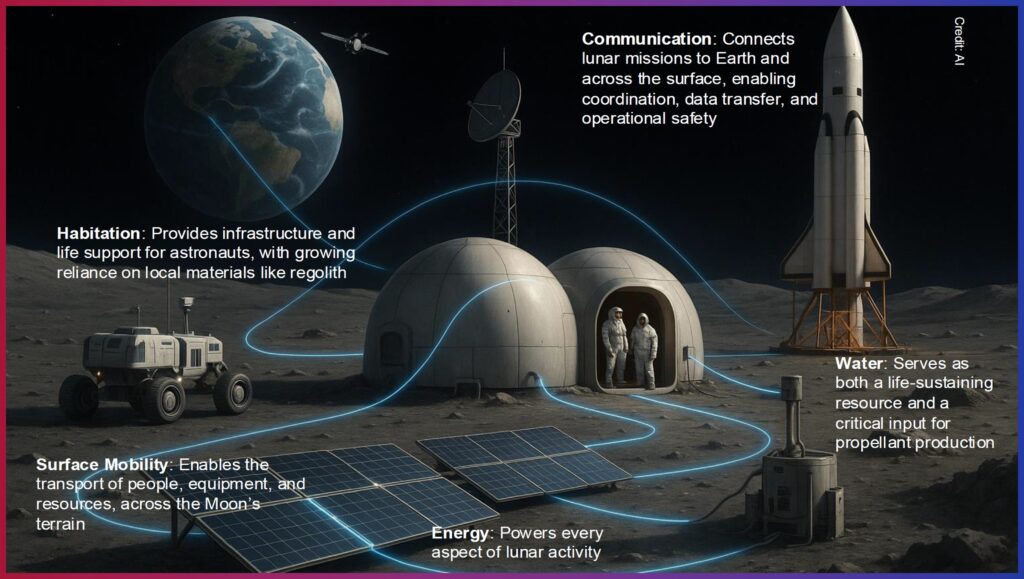
- Mobility: Transport and logistics solutions between Earth, lunar orbit, and the lunar surface—from landers and cargo spacecraft to rovers and service missions. These form the backbone of all other activities.
- Communications: Data infrastructure for navigation, control, teleoperation, and commercial services. Relay satellites, ground stations, and high-performance data links ensure a continuous flow of information between the Moon and Earth.
- Energy: Energy is the most critical bottleneck. The 14-day lunar night, in particular, requires a reliable, scalable power supply—such as nuclear systems, specialized solar technologies, and storage solutions. Without energy, there can be no sustained presence.
- Habitats: Living and working environments that integrate radiation protection, temperature control, life support, and functional work areas. Additive manufacturing and the use of local materials (regolith) reduce costs and enable on-site construction.
- Water: Water is the foundation of life, a source of energy, and an industrial raw material. Polar ice can be processed into drinking water, oxygen, and hydrogen—the cornerstone of a self-sufficient, local supply.
Stages of development
Phase 1 (2020s): Government programs such as NASA’s Artemis program, ESA missions, and CNSA activities are building infrastructure, demonstrating technologies, and lowering barriers to entry.
Phase 2 (2030s): Commercial entities take over transportation, logistics, and initial surface services; business models centered on energy, communication, and data emerge.
Phase 3 (2040–2050): In-situ resource utilization (ISRU) enables local value creation. Water, metals, and regolith are extracted and processed on site; a self-sustaining lunar economy emerges.
Key Technologies
Technology will determine whether the lunar economy becomes economically viable:
ISRU: The use of local resources reduces transportation costs and dependence on Earth-based logistics.
Energy innovations: Reactors, robust PV systems, and storage solutions bridge the gap during lunar nights and enable continuous operation.
Additive manufacturing: 3D printing with regolith shortens construction times and reduces launch mass.
Autonomous systems: AI-powered rovers and robots take on dangerous, monotonous, and remote tasks and boost efficiency.
Why this is relevant for leaders
The lunar economy is not some distant pipe dream, but an emerging market with real projects, tenders, and investments.
Act now: Long development and infrastructure cycles reward early market entrants. Those who build expertise in energy, robotics, or materials technologies early on gain a technological edge that competitors will find difficult to catch up with later.
Leveraging technology transfer: Investments in lunar technologies pay off twice over. Solutions designed for extreme environments (efficiency, miniaturization, robustness, autonomy) open up immediate applications on Earth.
Thinking in terms of ecosystems: Value is created through interconnected value chains. Companies should define their role in the emerging lunar ecosystem: as infrastructure providers, data service providers, raw material processors, or logistics partners.
Keeping an eye on regulations: Property rights to resources, international agreements, and national space laws will shape the future rules of the game—those who understand them early on can help shape them.