
































Dr. Pero Mićić
Will rising energy costs force me to downsize my company? Or move it abroad? We do not have enough land for solar and wind, do we?
Let us focus on solar and land use. Solar is not constrained by land scarcity. The real bottlenecks are build-out speed, capital for grids and storage, and political and regulatory friction.
“Our World in Data” reports that humanity uses around 32 million hectares of land to produce liquid biofuels (from corn, rapeseed, sugarcane, soy…). That is roughly the land area of Poland or New Mexico. This land is already tied up and is not available for food production.
If you covered that already-used land with solar panels, you could generate enough electricity, in theory, to power all of the world’s cars and trucks. Per Our World in Data.
Yes, all of them. Not only today’s electric vehicles, but the full global fleet once all 1.5 to 1.8 billion cars and trucks are electrified. And they will be.
Storage would largely come with the vehicles themselves. That leaves the grid, where massive investment is underway.
It gets even better: 22% of Poland’s area (please, it’s just a mental reference) would be enough. On 32 million hectares of photovoltaics you could generate about 32 PWh (32,000 TWh) per year, while all cars and trucks combined would need only about 7 PWh once fully electrified.
Why is the difference so large? Biofuels deliver roughly 10–25% “source to wheel” efficiency. But the “sun to wheel” efficiency of biofuels is only about 0.3–0.5%. With electricity from photovoltaics on the same land, an electric vehicle can travel about 70 times farther than a biofuel-powered vehicle. Put differently: for the same distance, biofuels require around 70 times more land.
And that land does not have to be lost. Elevated agrivoltaics allows farming to continue underneath the panels, and in some locations the shade can even benefit certain crops. A cornfield grown for biofuels is single-use. Convert that field to agrivoltaics and it can produce electricity while also returning to food crops. Compared to today, that would free up more land for agriculture.
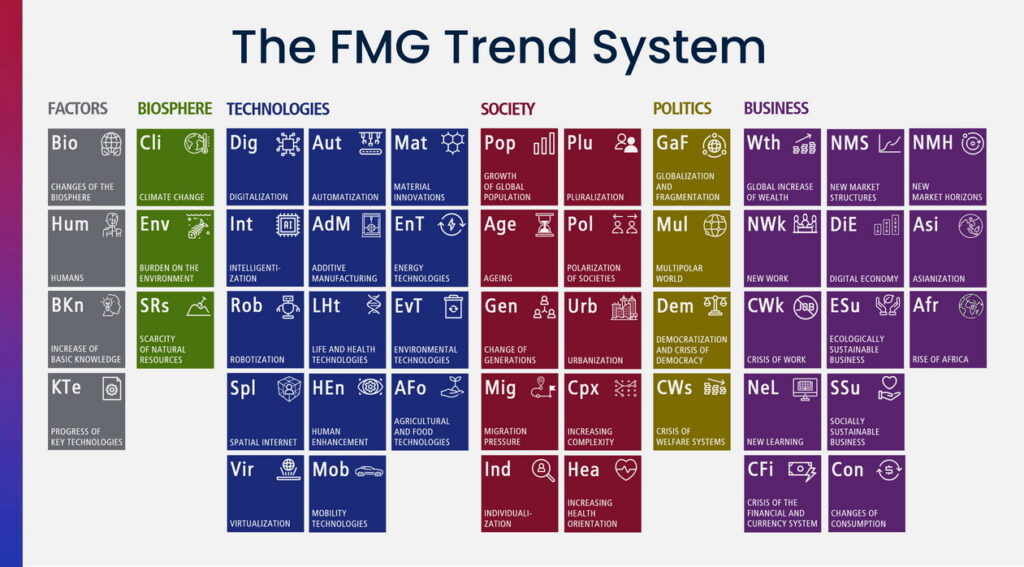
If you also consider that with today’s technologies roughly 75% of an industrial country’s total energy demand can be electrified (according to Ember), you can see why one of our trend scenarios is highly plausible:
Energy will keep getting cleaner and cheaper.
Recommendations:
- Deliberate downsizing is not rational. Energy supply, at least, is not the reason to do it.
- Put energy into CEO metrics.
- Electrify your largest energy users first.
- Increase your energy autonomy. You likely have investable surfaces nearby. The return is not only financial; it should also be measured in resilience and security.
Have a bright future!